

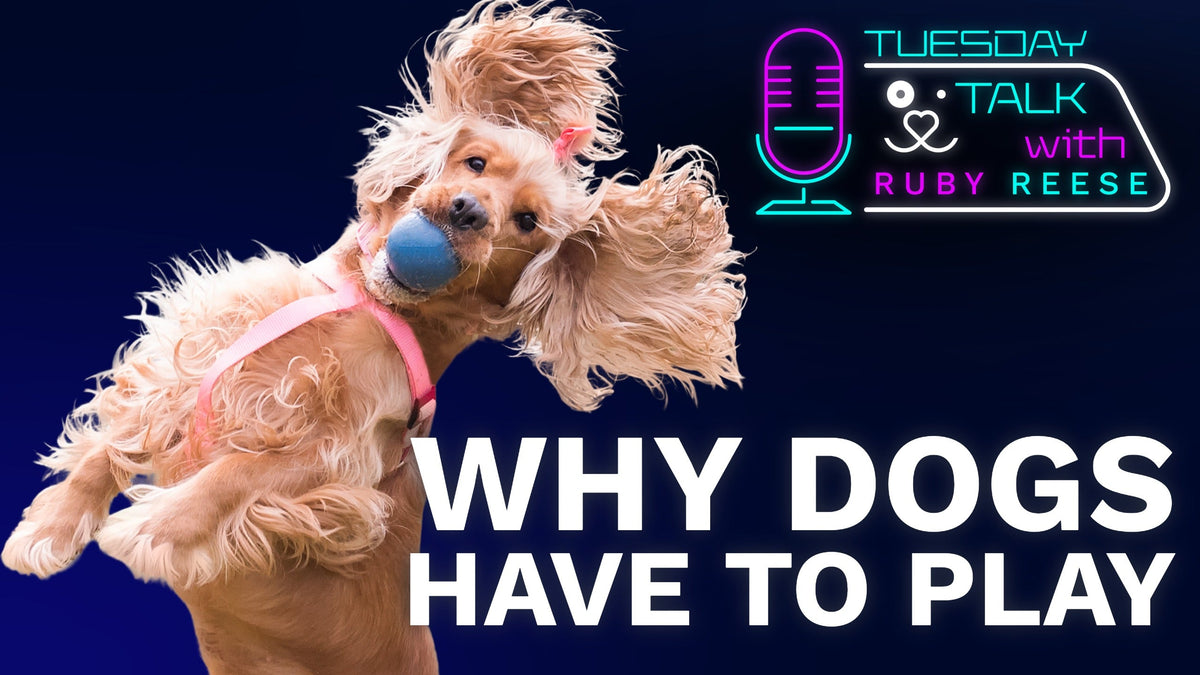
In this episode of Tuesday Talks with Ruby Reese, Killian is rejoined by Suzi Walsh, animal behaviourist and founder of dogbehaviour.ie, for a wide-ranging and genuinely enjoyable conversation about the importance of play for dogs.
Suzi unpacks what play actually means - and why it looks different for every dog depending on breed, age, history and personality. She explains how play supports brain development, emotional regulation and bonding, and what the science tells us about what happens in the brain during play. The conversation covers solo play, interspecies play, and the often underestimated value of playing directly with your own dog.
Suzi also addresses some of the biggest misconceptions around play - including the myth that dogs should want to play with every dog they meet, the problems with over-relying on fetch, and why a tired dog is not always a happy one. She shares how play features in her behaviour modification work and why mixing up activities - particularly those that involve sniffing and problem-solving - is so important for mental wellbeing.
A warm, practical and thought-provoking listen for every dog owner.
Takeaways
- Play is anything a dog does for enjoyment outside of basic needs - it looks different for every dog depending on breed, age, history and personality, and there is no single standard definition.
- Play supports brain development, emotional regulation and the ability to communicate boundaries - dogs who are deprived of play early in life often struggle to control their emotions as adults.
- Playing directly with your own dog - rather than just letting them play with other dogs - is one of the most valuable and underestimated tools for building trust and strengthening the human-dog bond.
- Dogs should not be expected to want to play with every dog they meet. As dogs mature, they naturally become more selective about their playmates, and forcing interaction is neither healthy nor fair.
- A tired dog is not always a happy dog. Over-exercising or over-stimulating a dog can be as problematic as under-exercising, and excessive physical exercise to manage behaviour is usually a sign something else is going on.
- Fetch is one of the most overused and least mentally stimulating forms of play. Dogs that appear obsessed with fetch may be masking underlying discomfort, as the activity releases adrenaline and dopamine that can temporarily mask pain.
- Mental stimulation through play - particularly sniffing games, hide and seek, and problem-solving - is just as exhausting and often more satisfying for dogs than physical exercise alone.
- Good play has natural breaks, with dogs mirroring each other's body language and naturally calming themselves down before re-engaging. If that is not happening, it is time to intervene.
- Play can be woven into everyday activities - scatter feeding on a walk, making training feel like a game, or using a flirt pole instead of a ball - to keep things varied and genuinely enjoyable for the dog.
- Just five minutes of dedicated, engaged play with your dog each day can have a significant positive impact on their emotional wellbeing and on the quality of your relationship.
Websites & Social Media
Suzi Walsh - dogbehaviour.ie
Website: dogbehaviour.ie
Instagram: @dogbehaviour.ie
References
Affenzeller, N., Palme, R. & Zulch, H. (2017). Playful activity post-learning improves training performance in Labrador Retriever dogs. Physiology & Behavior.
Beerda, B. et al. (1997). Manifestations of chronic and acute stress in dogs. Applied Animal Behaviour Science.
Beerda, B. et al. (1998). Behavioural, saliva cortisol and heart rate responses to different types of stimuli in dogs. Applied Animal Behaviour Science.
Horváth, Z. et al. (2008). Affiliative and disciplinary behaviour of human handlers during play with their dog affects cortisol concentrations in opposite directions. Hormones and Behavior.
Miller, S. L. et al. (2022). The importance of evaluating positive welfare characteristics and temperament in working therapy dogs. Frontiers in Veterinary Science.
Rooney, N. J. & Bradshaw, J. W. S. (2003). Links between play and dominance and attachment dimensions of dog–human relationships. Journal of Applied Animal Welfare Science.
Rossi, A. et al. (2018). Hormonal correlates of exploratory and play-soliciting behavior in domestic dogs. Frontiers in Psychology.
Shiverdecker, M. D., Schiml, P. A. & Hennessy, M. B. (2013). Human interaction moderates plasma cortisol and behavioral responses of dogs to shelter housing. Physiology & Behavior.
Sipple, N. et al. (2021). Intraspecific and interspecific attachment between cohabitant dogs and human caregivers. Integrative and Comparative Biology.
Chmelíková, E. et al. (2020). Salivary cortisol as a marker of acute stress in dogs: a review. Domestic Animal Endocrinology.
Please Note: In the interest of keeping episodes conversational and entertaining we will make broad generalisations that may not reflect you, your situation or your pet. If you have any concerns please consult a certified professional who will assess your individual needs.

0 comments